Mongolia (5-8 July 2012)
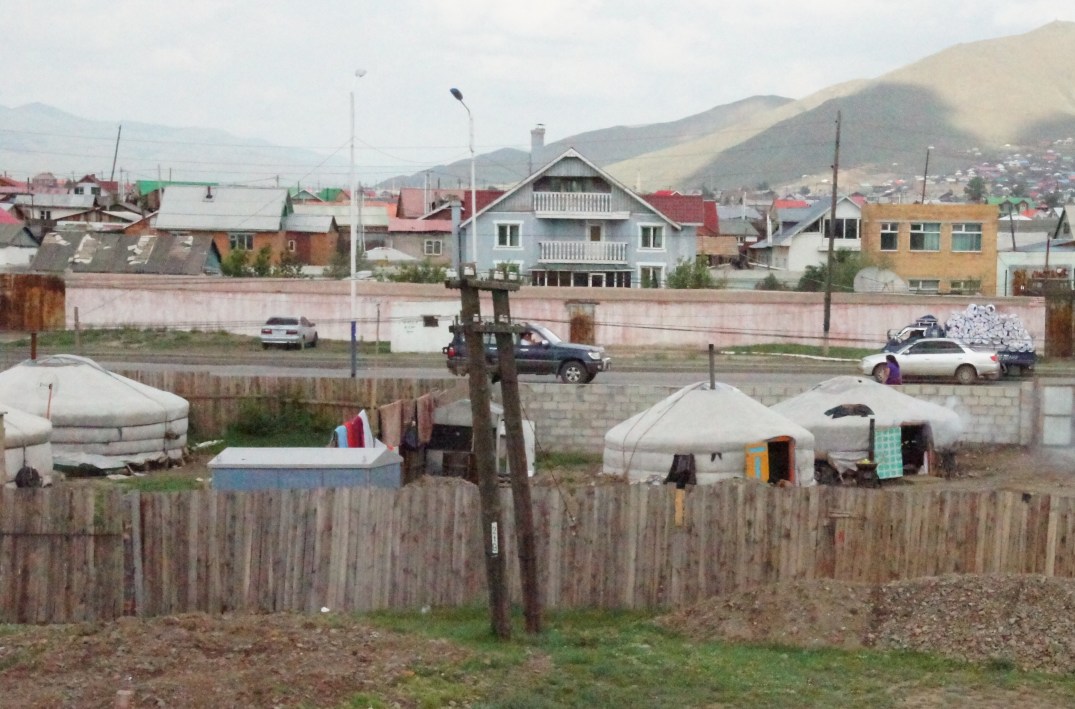
Arriving to Ulaanbaatar by train, it is hard to reconcile modern housing with a profusion of Gers* in the back gardens.
But it is so, well marked individual private properties where you can see sometimes a western style house, side by side a Mongolian ger, with all its trimmings. I had always imagined gers as part of the landscape of the Gobi desert and not an urban element.
Once in the capital, I alighted and was received by my guide, a young man with a reasonable level of English which could nonetheless be improved for ease of understanding but… his English was thousand times better than my Mongolian, so first thing first, I asked him to take me to the bank, as money makes the world go round, also in Mongolia. The bank was modern, clean and as always when you are in a relative hurry, full of people that have some time-consuming activity with the cashiers, but… you take your number and wait. My turn came and I wanted to change my Chinese currency into Mongolian Tögrög, and I leave the pronunciation to you! I received my Mongolian bills but one was almost torn in two, so I asked the teller to change it, as I would not be able to pay with that, many shops might refuse it. My guide was pleasantly surprised of my savvyness in refusing a torn note as if that was not the rule. Then I needed to go to the post office, I wanted
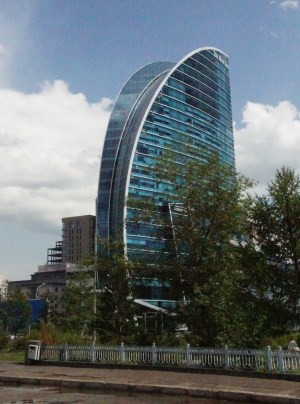
- New modern hotel
to buy stamps, for postcards to a very limited number of friends to let them know that so far I was still around, and for my collection, which one day, maybe, will be updated and put in order. We walked to the post office and their collection of stamps was just great, I believe I got as many as I could to mail letters to the better half of the world population, although in reality one day they will ornate my stamp collection.
The city had just received a summer shower that meant lots of pools in the middle of the road and pedestrian crossings, where cars did not really cared to keep the trousers of the pedestrians more or less dry and clean, so it was up to the pedestrian to jump, backwards or forwards to keep clean, but to keep safe was another matter, as jumping forward meant the risk of dirty trousers/pants was great but that of broken or smashed limb by the cars was even greater, so the alternative was, for me, to bring out my Mexican instincts and cross the streets “toreando” (popular Mexican way to describe dodging the cars) the cars, it is risky, but for those of us that learned it in childhood, gives us the extra edge to cross more or less safely.
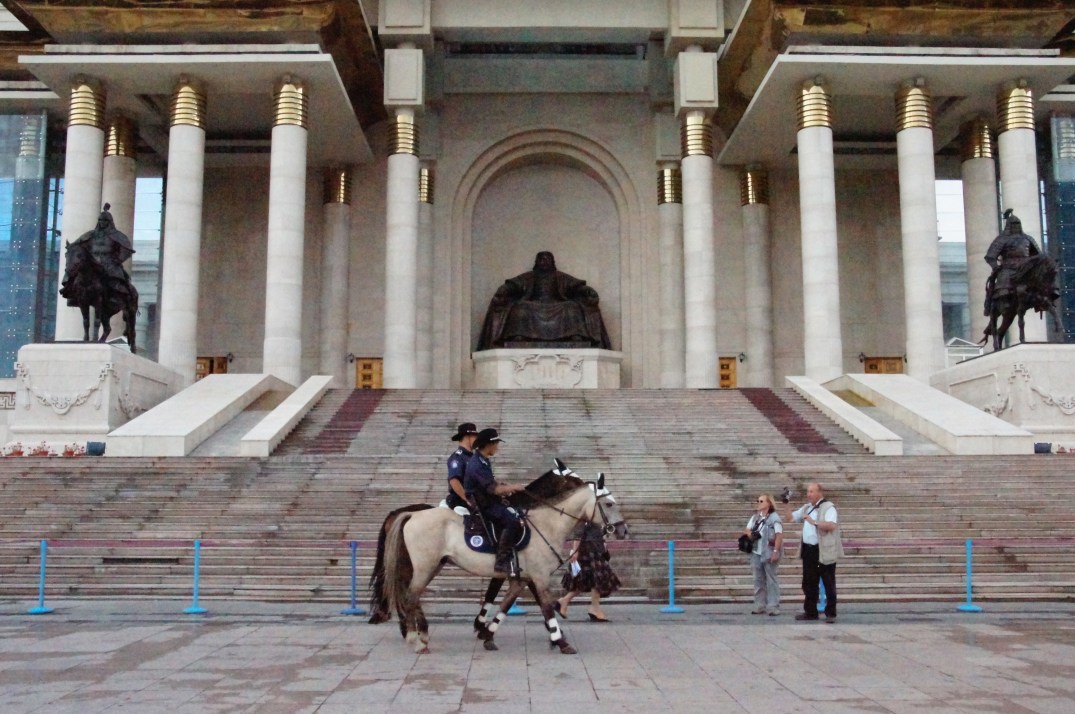
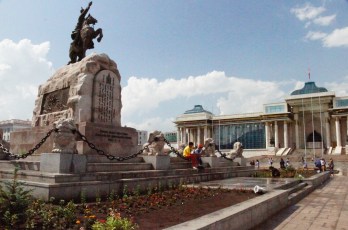
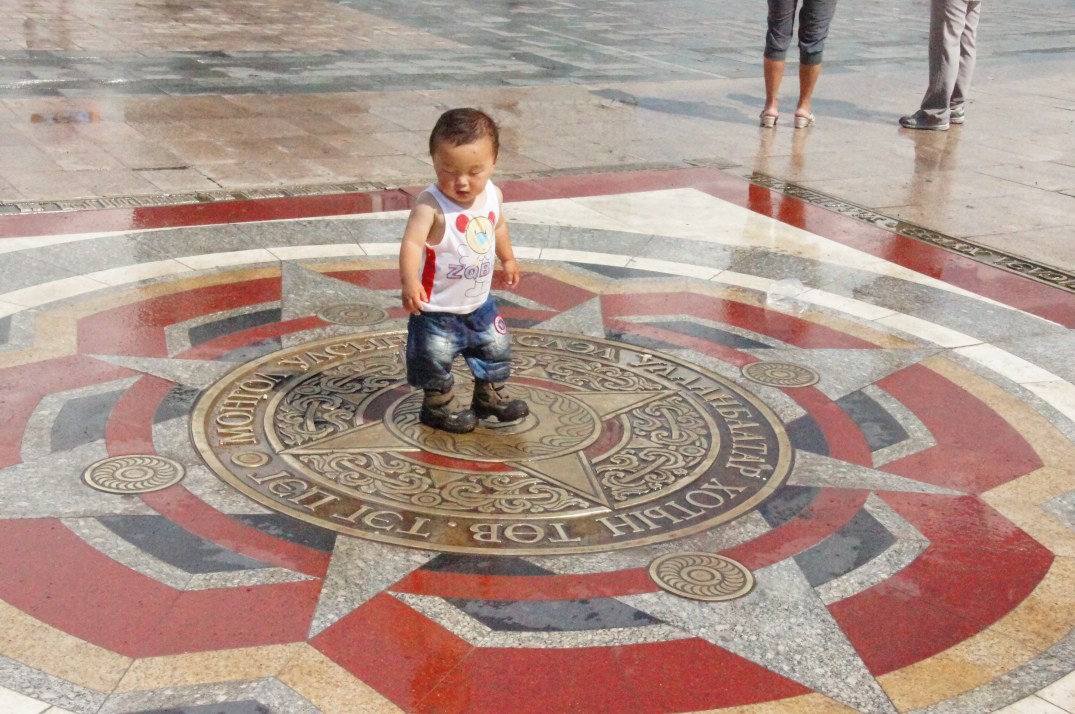
Then the city tour begins. We are in the main square of UB, huge, with a big statue in the middle and an even bigger at the far end, of a sitting person that now I know that is Genghis Khan, but it is pronounced Chingis Khaan, long “a” sound please. Once you get the pronunciation right, the explanations continue and at one point we see ground “Zero” of Mongolia, so I am in the middle of their world!! Turning around we can see the new front of the parliament, with Chingis Khaan overlooking everything and everyone, the opera, office buildings, new hotels, etc. etc. and of course work in progress, roads being fixed, holes being closed or opened, cars, cars, and more cars of all forms and shapes, mostly middle old.
Finally after that we come to the inevitable tourist trap, the cashmere shop, where you can find all you ever dreamed on cashmere and were never able to afford!!! Maybe In Ulaanbaatar also, tourists are seen mainly as the eternal “rich-and-dumb-that-can-be-milked-at-will-anyway-they-do-not-understand-our-language” type. You do not dream anymore, but you still cannot afford it, so be it. The trap, sorry, the shop is full of Russians of all forms and colours, blonds, brunettes, fat red-nosed big bellied gentlemen etc. etc. all speaking Russian, which means you do not understand one single word, who cares, you want to leave with as little damage to your credit card as possible and I was able to spot sets of scarves and bonnets, nice and not too heavy, neither for the suitcase nor for the credit card, so I leave with my war loot and then we start our trip to the camp where we are to staying for 2 nights.


The camp is located 50 km from UB through hilly country with a decreasing number of cars, trucks, buses, etc. We finally made it to the camp of gers planted around a central building which I will learn later, is the dining room, recreation room and the area of showers and toilets. We are informed hot water is available from 5 to 10 am and pm. The gers are all the same size, weather you are alone or a family of 10, you get your stuff in order and it is already time for dinner. Do not forget your flashlight for the return, as you must cross the wilderness to your tent-ger. Dinner is relatively uneventful but you share your meal with your guide, who takes advantage of the captive audience to instruct you on the uses and traditions of the locals and on how to behave when visiting their gers tomorrow. Some of the rules are: never enter a ger with the left foot; when you enter, sit on the left side, the side of the men and the guests, the right side is reserved for the women and family matters, not for guests; the deep end of the ger is devoted to deities, you should not touch anything there; beware of your manners when accepting or rejecting food offered to you. Like that, many other behavioural rules when visiting a ger.
In the early hours of a day in the camp it is possible to hear the silence of the countryside. Nothing moves, fog everywhere dampens the light and the sound, your breathing sounds like a roar, the light steps of animals feel like a careless dinosaur running around your ger. The noise of silence is like moving in the vacuum of life. At the same time the awakening of the camp is slowing becoming a noisy event, doors clap like thunder, whispered words sound like a noisy revolution. When rain falls it sounds like the deluge falling on your head and if your ger has a leak, then the deluge is actually falling IN your ger, on your head. Fixing the roof in our western homes requires probably changing some tiles or waterproofing the roof, but in a ger, in my ger in particular, the solution was simply take a long stick and move the plastic roofing, to redistribute the weight of the water on the top of the roof so it falls outside and not inside. It was done in a matter of minutes and then on top of that they turned on the stove, with a bit of coal and the fire and heat last like forever.
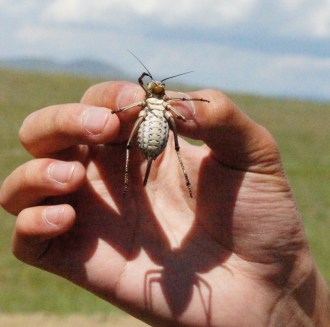
Finally the time has come to pay a visit to a group of nomads, camping close to our camp. We started our walk surrounded with the noise of silent, only broken by giant crickets and the soft wind of the morning.

Upon arrival, after entering with the right foot and sitting on the left side of the ger, you are offered tea with sour milk and salt that is not to really for my taste buds, but it cannot be refused without at least pretending you try it (rule number 250,000 of the well behaved tourist when visiting a nomad’s tent), so wet your lips and then you can place it on the table and not touch anymore, although your hosts will drink it with delighted relish all along the visit. You will be offered several cooked goodies, mostly made of dairy products but with an indefinable look so unless you are very adventurous, which I am not, express your delight and indicate you have a delicate stomach or that you just had an inordinately big breakfast and cannot fit another morsel of food. You stare at your hosts and they stare at you and that is the visit, unless of course, you decide to start asking some questions about them, their life style, their home, etc, at the risk of sounding more curious that is adequate for a first (and last) encounter. However, since you are not their fist visitor and will not be their last, they expect those questions and through your interpreter – unless you are fluent in nomadic Mongolian, it is advisable to have a good interpreter at hand, who as all interpreters know, will translate what he wants as he wants, but you are totally and irrevocably dependent on him…. You ask about the baby present, who does not belong to your hosts but to the neighbour, and then, suddenly, you see an iron, and electric iron in a tent without electricity, they are nomads, no generator, no wires, no nothing and my first thought was, is the iron part of their religious world??? It cannot be so, therefore the question is, how do you use an iron if you do not have electricity and the answer comes quick and clear – “we have electricity through our solar panel” et voila! In the middle of nothingness these nomads have a solar panel. I need to see it, so I mention this and we go outside and of course, next to the ger theye have a solar panel on a stick, taking up as much sun as possible to power the iron and maybe even a radio or some other appliance. My first thought was how these people could have a solar panel without any problem and me in my civilized world, to have one, need to fill up about three tons of paperwork, ask permission from all human beings in the surrounding 4 kilometres, and even then, pay through the nose for it, have to sell my electricity to the state and then buy the one the state sells me, of course at a higher price and here we are in the plains of Mongolia, enjoying a free solar panel!!!
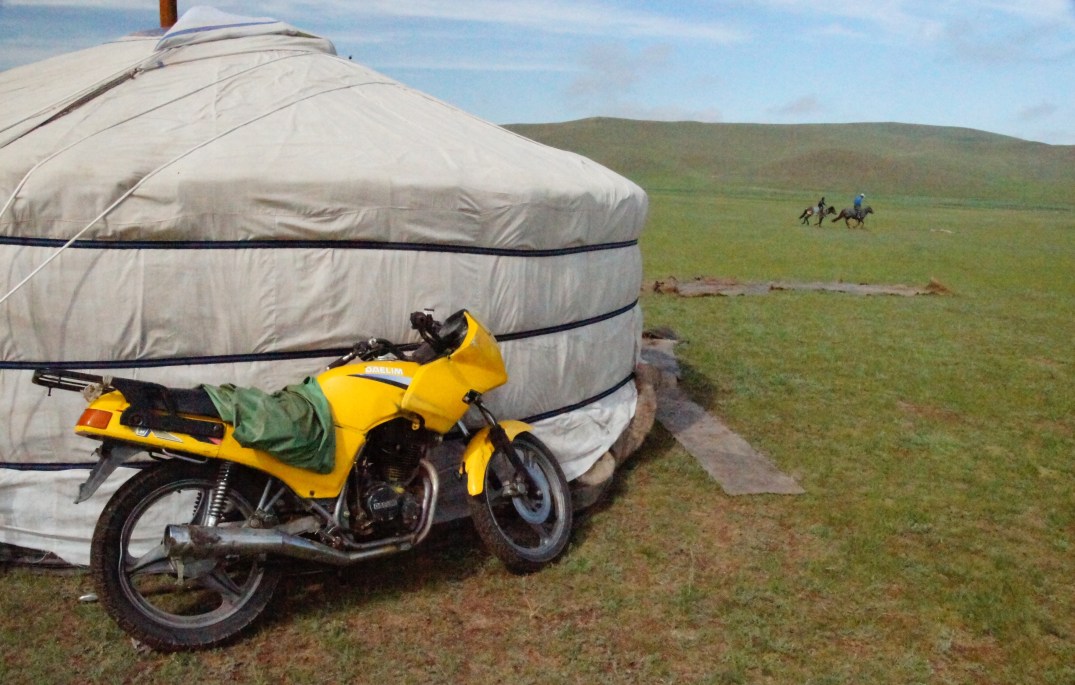
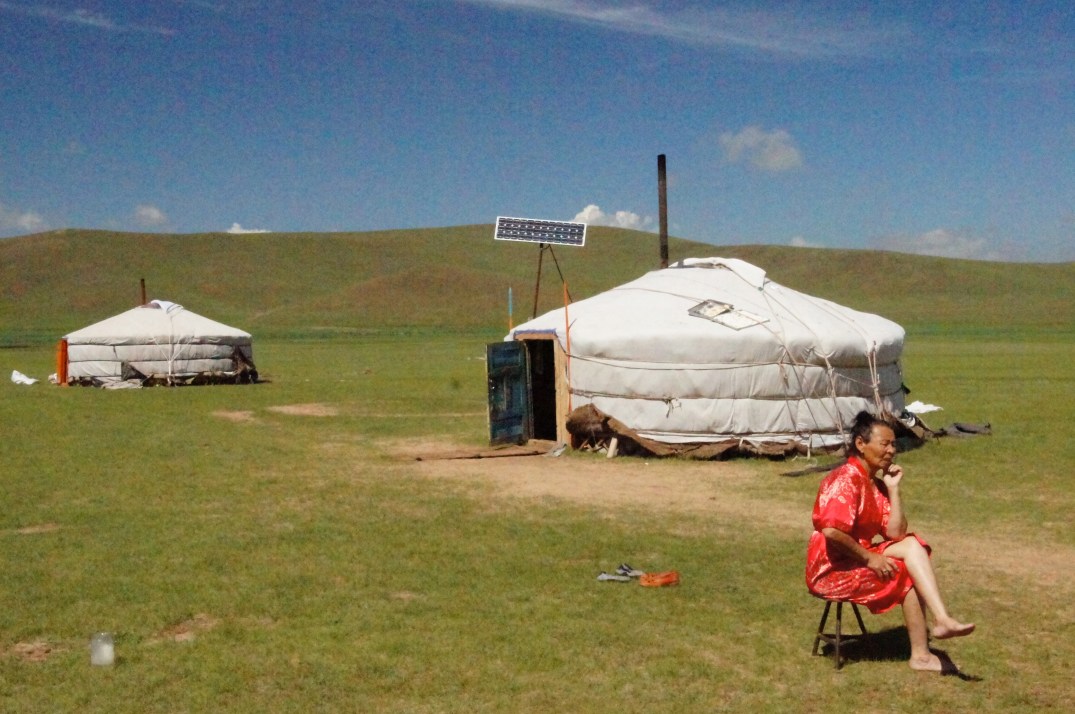
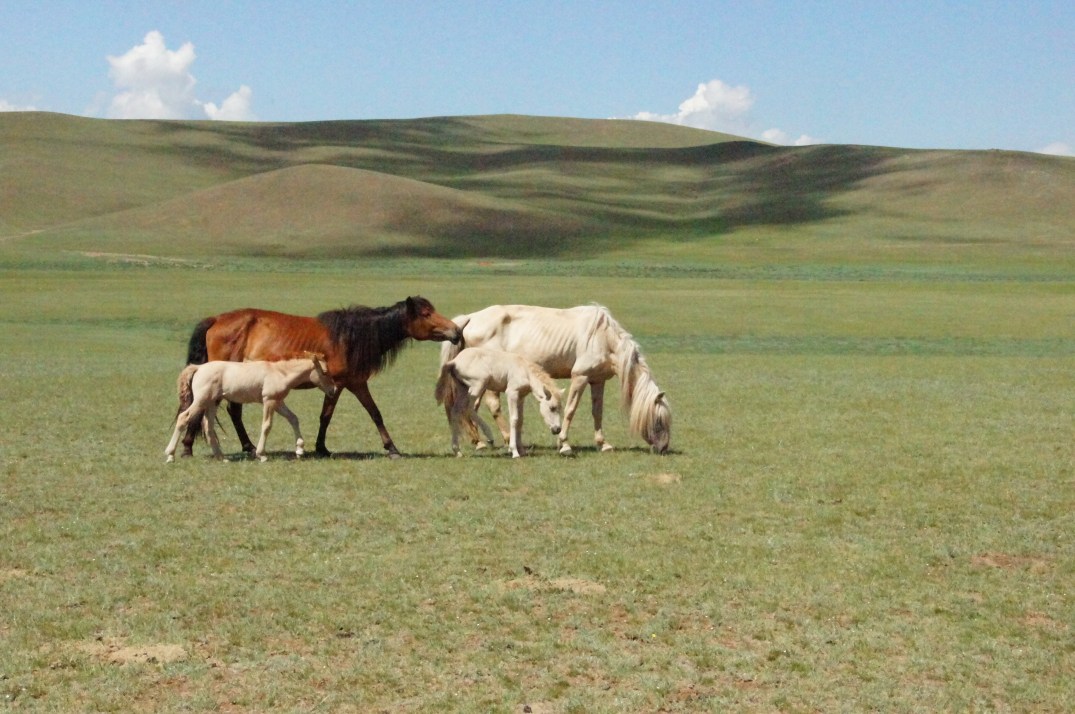
Once outside I discover they also have a very modern motorcycle, of course they also have horses, but for everyday is the bike. Also big drums with water for washing, showers, cooking and all other activities and when they run out of water, go to the nearest river – remember that nomads know where rivers are – and fill them up again, bring them to the camp in a chariot and that’s it. Then comes a natural question to a natural activity – toilet. Where is the toilet in a nomad camp where they do not have any running water, no latrine, no dry WC or the like… how and where is it done? My body was quicker than my mind in needing an answer to this no longer rhetorical question and so my hosts gets me a very thick and rather stiff coat, and shows me: you put it on as a cape and then once you have walked sufficiently far from the gers not to be a nuisance or make a spectacle of yourself, you squat down and the coat will become a tent around you that will protect you from indiscreet onlookers and give you a rather decent level of privacy.
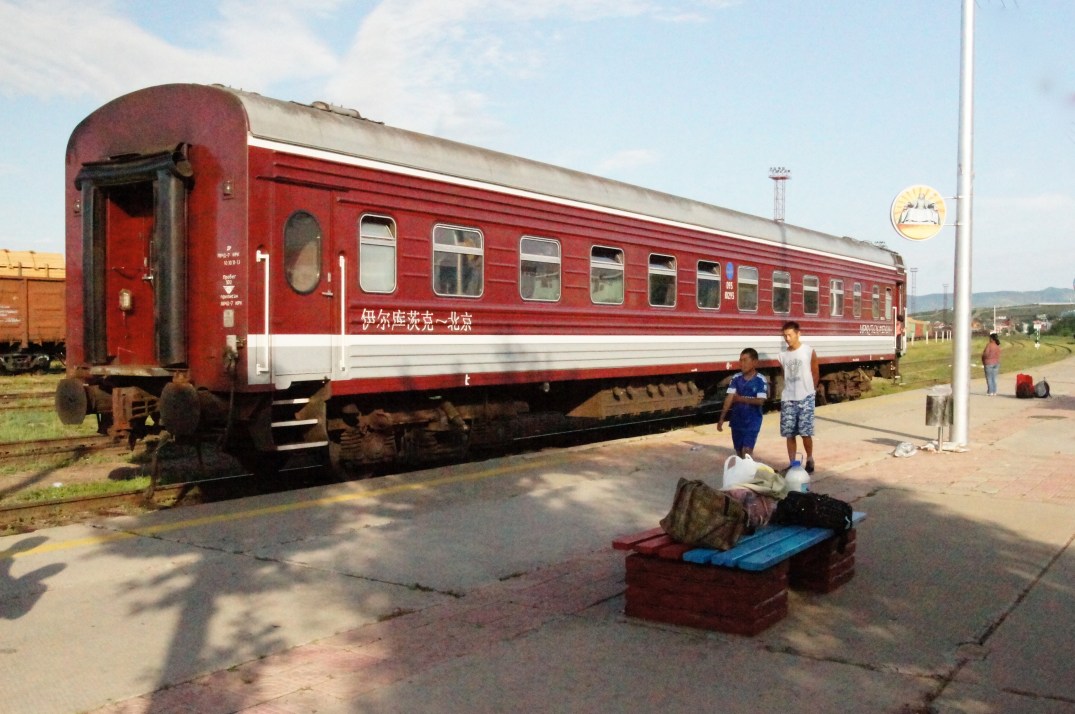
After the visit you thank the hosts and return to the camp, finish packing and start the return to UB. Getting close to UB the most obvious thing is the heavy traffic; one could think it is Friday afternoon in a big city. You finish your visit of the museums, the monasteries, the squares and then get ready to go to the train station and board your train that will take you, in due time, to the border with Russia and beyond.

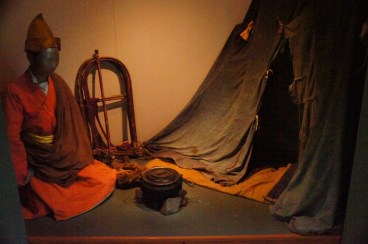
It is a strange feeling to leave this country where things look real, where silence is noisy and where people are smiley and seem peaceful, even if their national sports includes archery, wrestling and horseracing.
*(The Mongolic nomadic structure the ger is often wrongly referred to by westerners as a yurt but differs in that the heavier roof wheel (toono) is supported on posts and the roof ribs are straight rather than bending down at the wall junction. The wall lattice of a ger is constructed of straight pieces as opposed to the yurt’s curved lattice. Courtesy of Wikipedia).
 Mementos of my life
Tu vois , ce dimanche matin je lis tes histoires… J’adore ! Tes 3 jours à Istanbul m’ont bien fait marrer !
LikeLike